
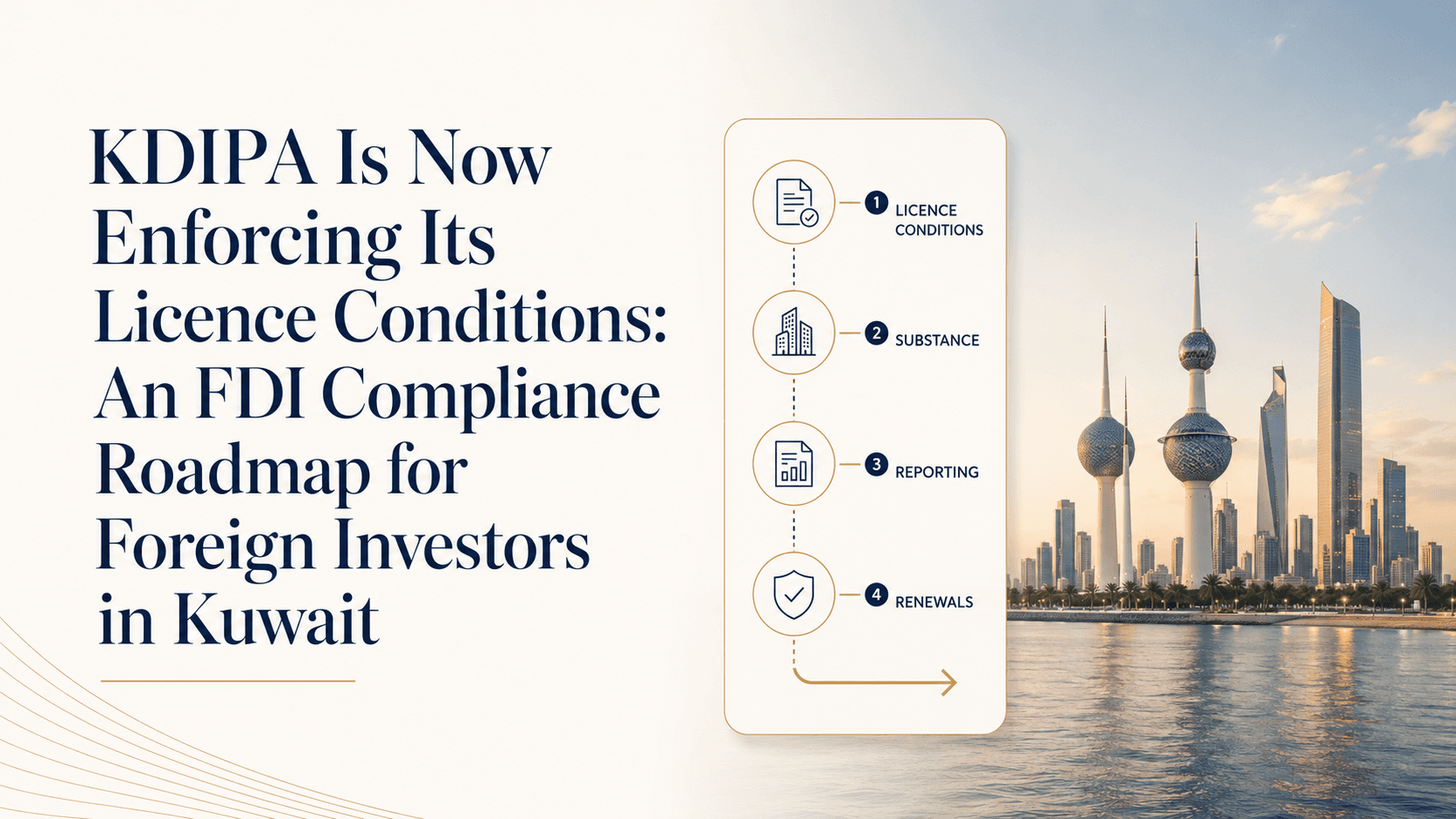
KDIPA Is Now Enforcing Its Licence Conditions: An FDI Compliance Roadmap for Foreign Investors in Kuwait
06-06-2026
KDIPAForeign InvestmentCompliance
What changed
For most of the last decade, the Kuwait Direct Investment Promotion Authority (KDIPA) has been understood primarily as a gateway and an incentive engine — the body that grants up to 100% foreign ownership, ten-year tax holidays, customs relief and land allocation under the Direct Investment Promotion Law No. 116 of 2013. The events of the last fortnight signal that the same authority now intends to be read in two directions: not only as the source of privileges, but as the body that withdraws them when licence conditions go unmet.
The clearest marker is Ministerial Decision No. 207 of 2026, published in the Official Gazette (Kuwait Al-Youm), Issue 1793, 31 May 2026, at page 76. It temporarily suspends the investment licence of a foreign power-sector entity for failing to employ the agreed number of Kuwaiti nationals, gives the company until 7 July 2026 to prove remediation, and expressly reserves the harsher penalty under Article 32 of Law No. 116 of 2013 if it does not. Local reporting (Times Kuwait, 1 June 2026) places this within a broader sweep: four foreign companies suspended or delisted in roughly two weeks following audit-driven compliance reviews.
Why this matters more than a single file
Three features make this an inflection point rather than an isolated penalty. First, the decisions are audit-led: Decision 207/2026 is built on follow-up and audit reports (December 2025 and April 2026) and a board resolution — i.e., a documented process, not an ad-hoc reaction. Second, the trigger is Kuwaitisation, the single condition most foreign investors treat as a soft target and the one most exposed to headcount fluctuations, project ramp-downs and subcontracting structures. Third, the cadence — four entities in two weeks — suggests a programme, not a one-off, and programmes tend to widen.
For investors, the legal architecture compounds the risk. KDIPA's national-workforce expectations sit alongside the Private Sector Labour Law No. 6 of 2010 and the Public Authority for Manpower's quota regime, so a single staffing gap can surface across more than one regulator. And because KDIPA incentives (tax, customs, land) are conditional, a workforce breach is not merely an HR issue — it can put the entire economic case for the Kuwait investment in play.
What foreign investors should do now
The practical response is not panic but documentation. A KDIPA licence is a bundle of measurable undertakings, and the authority is now measuring. We suggest five steps:
1. Reconcile the file. Pull the actual licence conditions (including the specific national-workforce ratio and any phased commitments) and compare them, in writing, against current headcount and payroll records. Most disputes turn on whether the agreed ratio was a fixed number or a trajectory.
2. Build an audit pack before the audit. KDIPA acted on follow-up reports; investors should hold their own — Kuwaitisation data, training and localisation evidence, and the value-added narrative (knowledge transfer, jobs) that the law rewards.
3. Treat remediation windows as litigation deadlines. The 7 July 2026 cure period in Decision 207/2026 shows these are short and hard. A suspension notice should trigger an immediate, lawyer-led response plan, not a wait-and-see.
4. Pressure-test the structure. Subcontracting, secondments and JV staffing can erode the headcount that 'counts' toward the ratio. Confirm that the people delivering the project are actually attributable to the licensed entity.
5. Map the cross-regulator exposure. Align KDIPA undertakings with PAM quotas and labour-law obligations so that fixing one does not breach another.
The opportunity inside the risk
Enforcement also clarifies the rules — and clear rules reward prepared investors. Kuwait still offers one of the region's more generous incentive packages, and the same audit discipline that suspended one licensee gives compliant investors a defensible, predictable footing. The investors who will thrive are those who can show, on demand, that their Kuwait presence delivers what the licence promised. That is a documentation and governance problem before it is a legal one, and it is eminently solvable with the right local counsel.
WEFAQ advises foreign investors and their group counsel on KDIPA licensing, condition management, audit response and representation before the authority. If your entity holds a KDIPA licence, the prudent move this quarter is a short compliance health-check — well before any audit letter arrives.
Sources: Kuwait Al-Youm, Issue 1793, 31 May 2026, p.76 (Ministerial Decision No. 207/2026, citing Law No. 116 of 2013, Art. 32); Times Kuwait, 1 June 2026; Private Sector Labour Law No. 6 of 2010. This article is general information, not legal advice.
Related articles


Eight Clearances, One Gazette: What Kuwait's Latest Merger-Control Batch Tells Global Dealmakers
Learn more
Yield on Idle Client Cash and a Bounded Margin Facility: A Broker’s Roadmap to CMA Resolution 85/2026
Learn more
Faster Benches: What Kuwait's Specialized-Court Reforms Mean for Business
Learn more
Kuwait's Disclosure Filing Switches to iFSAH Only: What Issuers, Licensed Firms and Auditors Must Do Now
Learn more