
Our News

Discover the latest News

Recent mandates, firm announcements, and news that matter to our clients and to the Kuwaiti legal market.

Kuwait's Competition Agency Publishes Two Cross-Border Merger Filings; 15-Day Objection Window Opens
Kuwait merger controlCompetition Protection Agencyeconomic concentration

Kuwait's Competition Agency Publishes Two Cross-Border Merger Filings; 15-Day Objection Window Opens

On 21 June 2026, Kuwait's Competition Protection Agency published two economic-concentration applications in the Official Gazette (Kuwait Al-Youm, Issue 1796, pages 176-177), opening the statutory window for any interested party to object. The first application concerns Sika AG (Switzerland), the global construction-chemicals group, which seeks clearance to acquire 100% of the share capital of three Turkish companies — Akim AYB Kimya San. ve Tic. (an industrial and commercial joint-stock company), Akdi Kimya, and Akim Europe S.à r.l. (wholly owned by Atlas Global YPI). Together these entities form the Akkim adhesives-and-sealants group, whose acquisition Sika announced publicly on 13 February 2026, with closing expected in the third quarter of 2026 subject to regulatory approvals. Sika has operated in Kuwait for decades through Sika Kuwait for Construction Materials & Paints W.L.L. The second application concerns Dr. Ing. h.c. F. Porsche AG (Germany), acting indirectly through its Luxembourg subsidiary Porsche Investments Management 1 S.à r.l., which seeks clearance to acquire 50% of the shares of KS Huayu AluTec GmbH (Germany), a manufacturer of aluminium castings. On completion, the target would fall under the joint control of the Porsche (Luxembourg) vehicle and Rheinmetall Asset Management Three GmbH (Germany). Both filings are made under Law No. 72 of 2020 on the Protection of Competition and Article 83 of its Executive Regulations (issued by Decision No. 14 of 2021, as amended). Under that article, any person with an interest may submit a reasoned objection to an economic-concentration application within 15 days of the date of notification or publication — here, on or before approximately 6 July 2026. Objections are filed at the Agency's headquarters (Burj Al-Hamra, 14th floor) using the form available on its website, against payment of the prescribed fee. The two notices illustrate the reach of Kuwait's merger-control regime over foreign-to-foreign transactions whenever the parties meet the applicable turnover thresholds through activity connected to the Kuwaiti market.

Learn more
Kuwait's CMA Approves Regulatory Framework for Exchange-Traded Funds (ETFs)
ETFsAsset ManagementCapital Markets

Kuwait's CMA Approves Regulatory Framework for Exchange-Traded Funds (ETFs)

The Capital Markets Authority (CMA) has approved a regulatory and legislative framework for exchange-traded funds (ETFs), clearing the way for the first ETF listings on Boursa Kuwait. Issued as CMA Resolution No. 80 of 2026 on Thursday 18 June 2026, the framework amends the Executive Regulations of Law No. 7 of 2010 (the Capital Markets Law), including Book 13 on Collective Investment Systems and the Book 12 listing rules, together with corresponding changes to the Boursa Kuwait and Central Depository rules. Boursa Kuwait described the approval as a pivotal milestone in modernising the country's capital markets, noting that the introduction of ETFs forms part of the second stage of the third phase of its Market Development Programme. The exchange said it would issue further amendments to its rulebook to accommodate the listing and trading of ETF products, and would coordinate clearing and settlement with Kuwait Clearing Company. The decision follows the launch of bonds and sukuk trading in April 2026 and is intended to broaden the range of investment products available to local and international investors. Following the decision, Boursa Kuwait Chief Executive Officer Mohammed Al-Osaimi said on 20 June that testing with market participants had confirmed the readiness of the trading infrastructure: “The exchange is now ready to receive listing requests and facilitate the trading of exchange-traded funds, ensuring a stable launch of this investment instrument in the Kuwaiti market.” Officials said the achievement reflects close coordination between the CMA, Boursa Kuwait and Kuwait Clearing Company, and supports the objectives of Kuwait Vision 2035 by enhancing market competitiveness and attracting foreign investment. For asset managers and issuers, the framework opens a first-mover opportunity to structure, license and list ETF products. WEFAQ advises fund sponsors and issuers on fund formation, listing-rule compliance, market-making and authorised-participant arrangements, custody and disclosure requirements under the amended regime. For a deeper look , the legal architecture, a seven-step listing roadmap, and the key risks for first movers, read our full analysis: Kuwait Opens the Door to ETFs: A Practical Roadmap for Asset Managers and Issuers . Disclaimer: This article is provided for general information only and does not constitute legal advice. For advice specific to your circumstances, please contact WEFAQ Law Firm.

Learn more
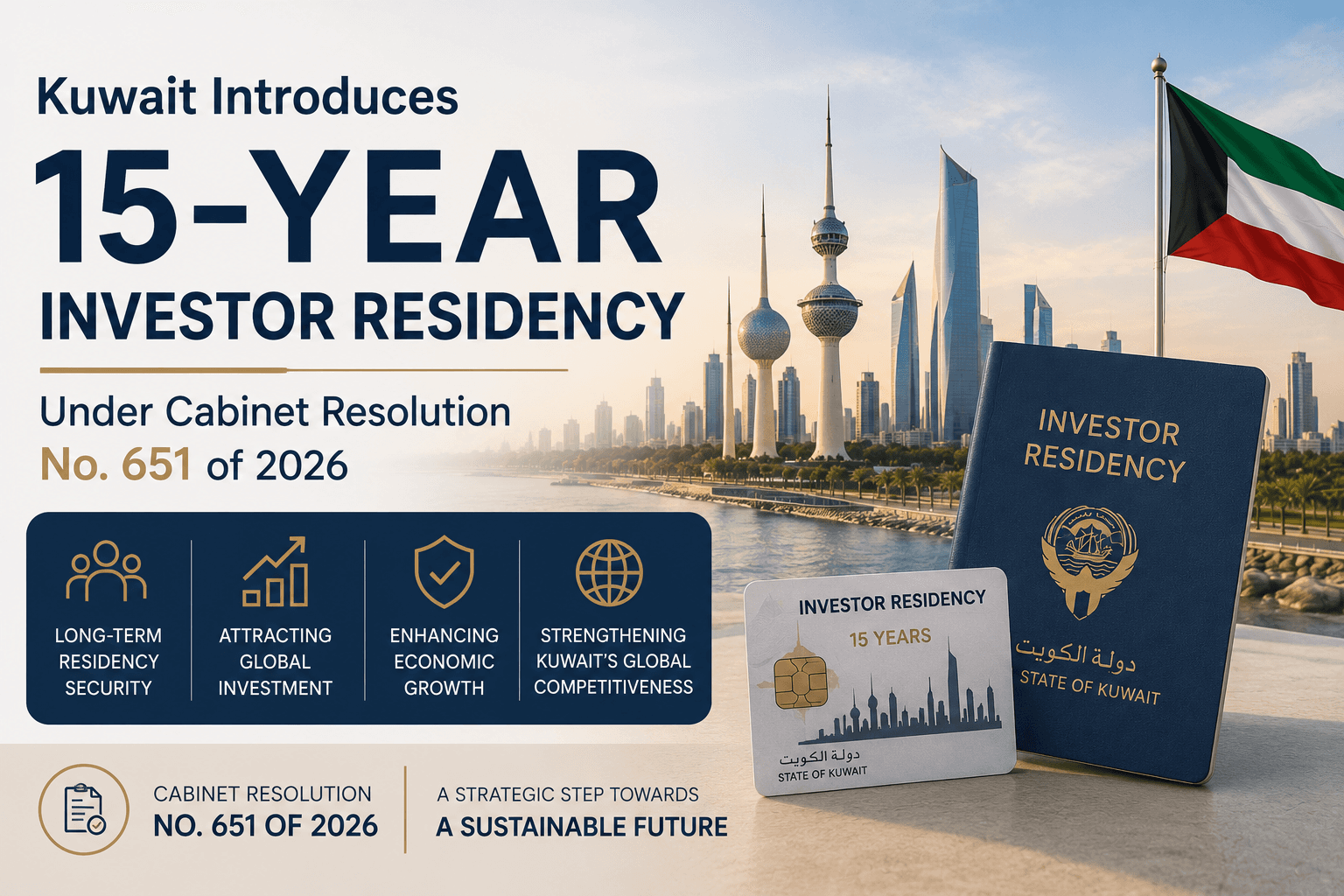
Kuwait Introduces 15-Year Investor Residency Under Cabinet Resolution No. 651 of 2026
Foreign Direct InvestmentInvestor ResidencyKDIPAResidency LawDoing Business in Kuwait

Kuwait Introduces 15-Year Investor Residency Under Cabinet Resolution No. 651 of 2026

Kuwait has established a long-term residency pathway for foreign investors. The Council of Ministers issued Cabinet Resolution No. 651 of 2026, published in the official gazette Kuwait Al-Youm, which authorises the General Directorate of Residency Affairs at the Ministry of Interior to grant an “Investor Residency” permit valid for up to 15 years upon referral from the Kuwait Direct Investment Promotion Authority (KDIPA). The measure was adopted under Law No. 116 of 2013 on the Promotion of Direct Investment. Eligibility extends to owners of the investment entity, partners, and directors and senior managers holding KDIPA-approved positions, together with their immediate family members. To qualify, the total investment volume must be no less than KD 5 million and the entity’s capital at least KD 1 million. On process, KDIPA reviews each application and must issue a decision within five working days of receiving a complete file. An applicant’s failure to provide requested information within 30 days results in automatic rejection. Renewal applications must be filed at least 60 days before expiry and remain contingent on the entity’s continued operation and ongoing legal, financial and regulatory compliance. The framework aims to strengthen foreign direct investment and support economic diversification under New Kuwait 2035, aligning investor residency with the long operational horizons of major KDIPA-licensed projects — bringing Kuwait into line with GCC peers that use long-term residency to attract capital. WEFAQ’s view: the resolution places KDIPA at the centre of both the licensing and residency tracks, so investors should plan the two workstreams together from the outset.

Learn more
WEFAQ Law Firm Shortlisted in Three Categories at the 2026 LexisNexis Middle East Legal Awards — Third Consecutive Year
Firm NewsAwardsRecognitionLexisNexisWEFAQ

WEFAQ Law Firm Shortlisted in Three Categories at the 2026 LexisNexis Middle East Legal Awards — Third Consecutive Year

WEFAQ Law Firm has been shortlisted in three categories at the 2026 LexisNexis Middle East Legal Awards, marking the third consecutive year the firm has been recognised by the region's premier legal awards programme. In the 2026 shortlist announced by LexisNexis Middle East, WEFAQ is named in: · Law Firm of the Year – Kuwait · Law Firm of the Year – GCC · Managing Partner of the Year — Bader Alqellaish, the firm's Founder and Managing Partner The recognition extends WEFAQ's run of shortlistings in 2024 and 2025. This year marks the firm's first shortlisting in the Managing Partner of the Year category, and an increase from two categories in 2025 to three in 2026 — with WEFAQ retaining its place among the finalists for both Law Firm of the Year – Kuwait and Law Firm of the Year – GCC. The LexisNexis Middle East Legal Awards recognise excellence, leadership, and innovation across the region's legal sector. Winners will be announced at a ceremony on 24 September 2026 in Dubai. WEFAQ Law Firm is a full-service Kuwaiti law firm advising on corporate and commercial, litigation and arbitration, banking, finance and regulatory, and real estate and construction matters, serving clients in Kuwait، across the GCC and the world. Learn more at wefaqlaw.com .

Learn more
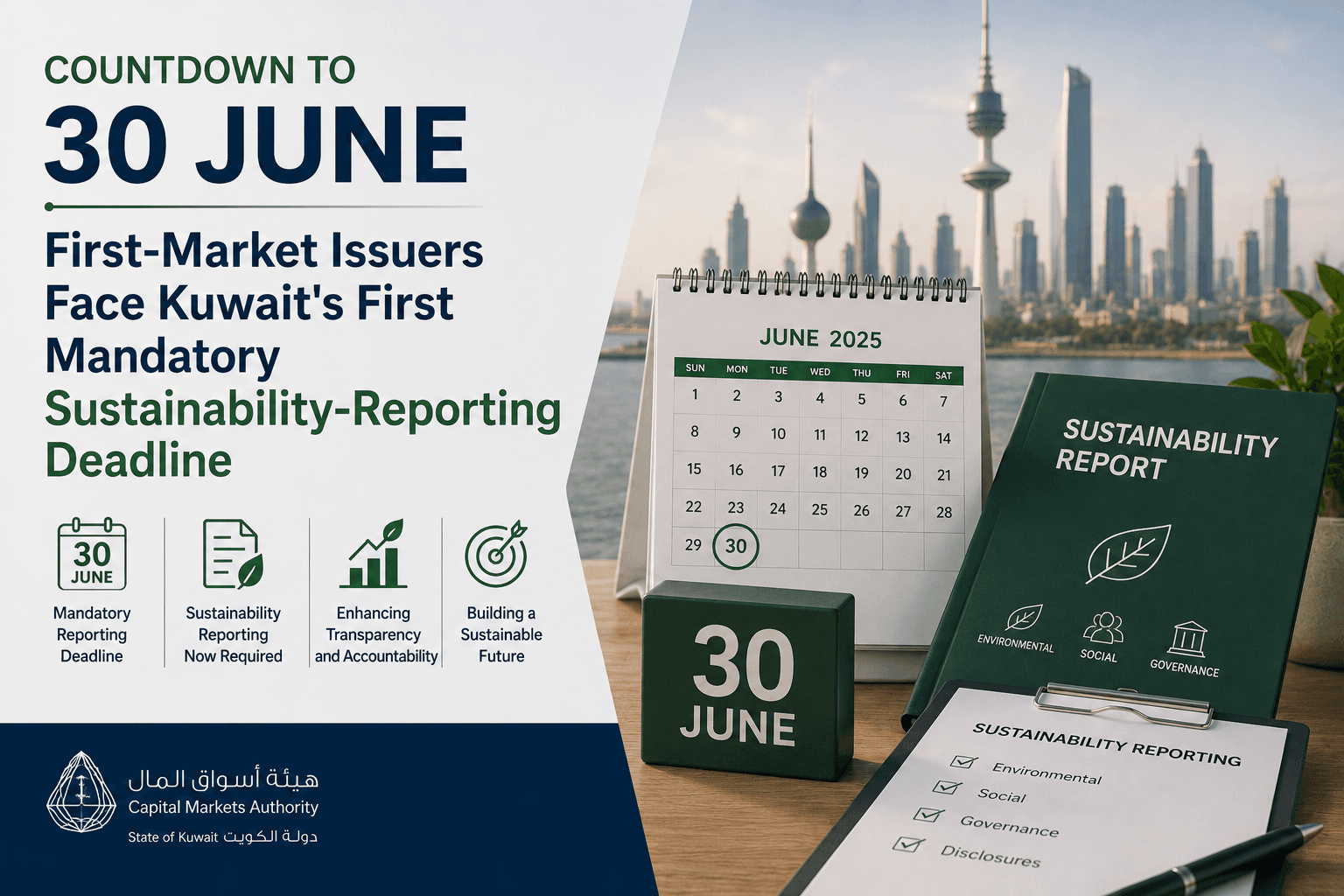
Countdown to 30 June: First-Market Issuers Face Kuwait's First Mandatory Sustainability-Reporting Deadline
ESGSustainability ReportingDisclosureCMABoursa Kuwait

Countdown to 30 June: First-Market Issuers Face Kuwait's First Mandatory Sustainability-Reporting Deadline

With less than three weeks remaining, companies listed on the First Market of Boursa Kuwait are approaching the deadline for Kuwait's first cycle of mandatory sustainability (ESG) reporting. Under Capital Markets Authority (CMA) Circular No. 4 of 2025, every First-Market issuer must prepare and publish an annual sustainability report covering financial year 2025, posted on the Exchange's website no later than the end of the second quarter of the issuer's financial year — 30 June 2026 for the December year-end majority. The obligation rests on Article (1-17-4) of Book Twelve (Listing Rules) of the Executive Regulations of Law No. 7 of 2010, read together with Article (1-8), which empowers the Exchange to set the form and content of the disclosure. Boursa Kuwait has issued its updated 2026 ESG Disclosure Guide, aligning the local framework with the IFRS Foundation's ISSB standards (IFRS S1 and IFRS S2) and expanding the indicator set to approximately 30 ESG KPIs from FY2025 — including climate-scenario analysis, transition planning and Scope 3 emissions. The move from voluntary practice to a listing-rule obligation changes the legal character of the report. A sustainability report is now a regulated market disclosure: its statements — particularly forward-looking climate commitments — carry accuracy and liability considerations comparable to financial reporting. Issuers that have not yet finalised and obtained board approval for their reports have a narrow window in which to act, and should ensure the disclosure is reviewed for misstatement and greenwashing risk before publication. WEFAQ is advising listed clients on disclosure governance, board sign-off and the legal review of forward-looking ESG statements ahead of the deadline.

Learn more
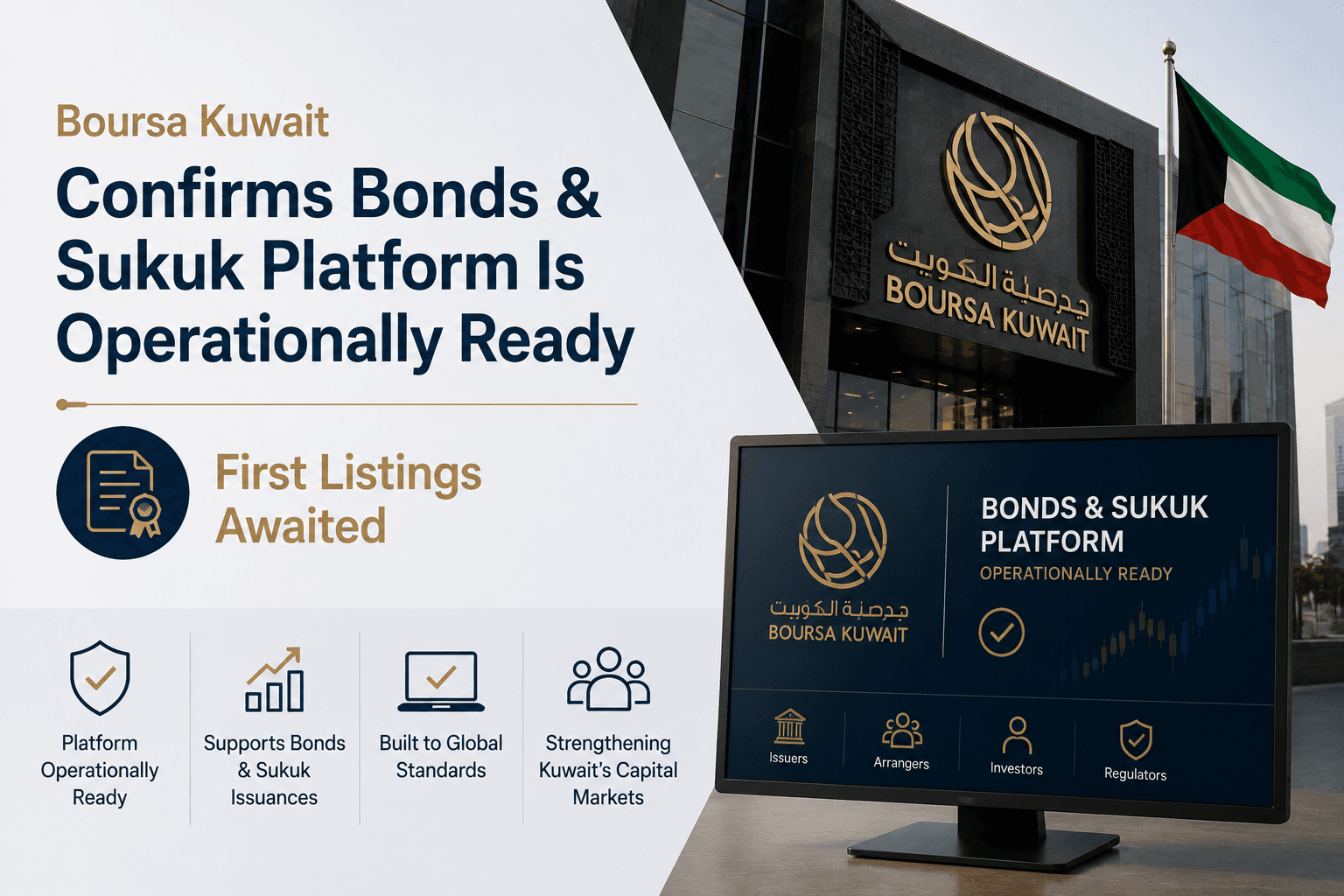
Boursa Kuwait Confirms Bonds & Sukuk Platform Is Operationally Ready; First Listings Awaited
BondsIslamic FinanceCapital MarketsBoursa KuwaitSukuk

Boursa Kuwait Confirms Bonds & Sukuk Platform Is Operationally Ready; First Listings Awaited

Boursa Kuwait has confirmed that its dedicated bonds and sukuk trading platform is fully operationally and technically ready and is now able to receive listing applications, Chief Executive Officer Mohammad Saud Al-Osaimi announced. The milestone completes the rollout of the framework introduced by Capital Markets Authority (CMA) Resolution No. 38 of 2026, which for the first time permits Kuwaiti and foreign issuers to finance their operations through bonds or sukuk listed and traded on the local exchange. Resolution No. 38 of 2026 amends the Executive Bylaws of Law No. 7 of 2010 (the Capital Markets Authority law) and governs the full lifecycle of fixed-income instruments — from issuance and listing through daily trading to early redemption or maturity. Boursa Kuwait gave effect to the regime through its own Resolution No. 1 of 2026, which amended the exchange rulebook to add provisions specific to bonds and sukuk and to create a separate trading board with sessions tailored to fixed-income securities. Key listing conditions include a minimum issuance value of KD 100,000 (or its foreign-currency equivalent), a credit rating from a recognised agency, free tradability without restriction, the appointment of a body to represent and protect holders, and Sharia compliance for sukuk. The framework is intended to give issuers a funding alternative to bank borrowing and a more diversified investor base. The readiness confirmation follows an awareness session held by Boursa Kuwait on 9 June 2026 in collaboration with the CFA Institute and CFA Society Kuwait. No corporate issuance had been listed on the new board as at the date of this note; instruments will be admitted as and when applicants satisfy the regulatory requirements. Source: CMA Resolution No. 38 of 2026; Boursa Kuwait Resolution No. 1 of 2026. This note is general information, not legal advice. For advice on a specific issuance, contact WEFAQ Law Firm.

Learn more

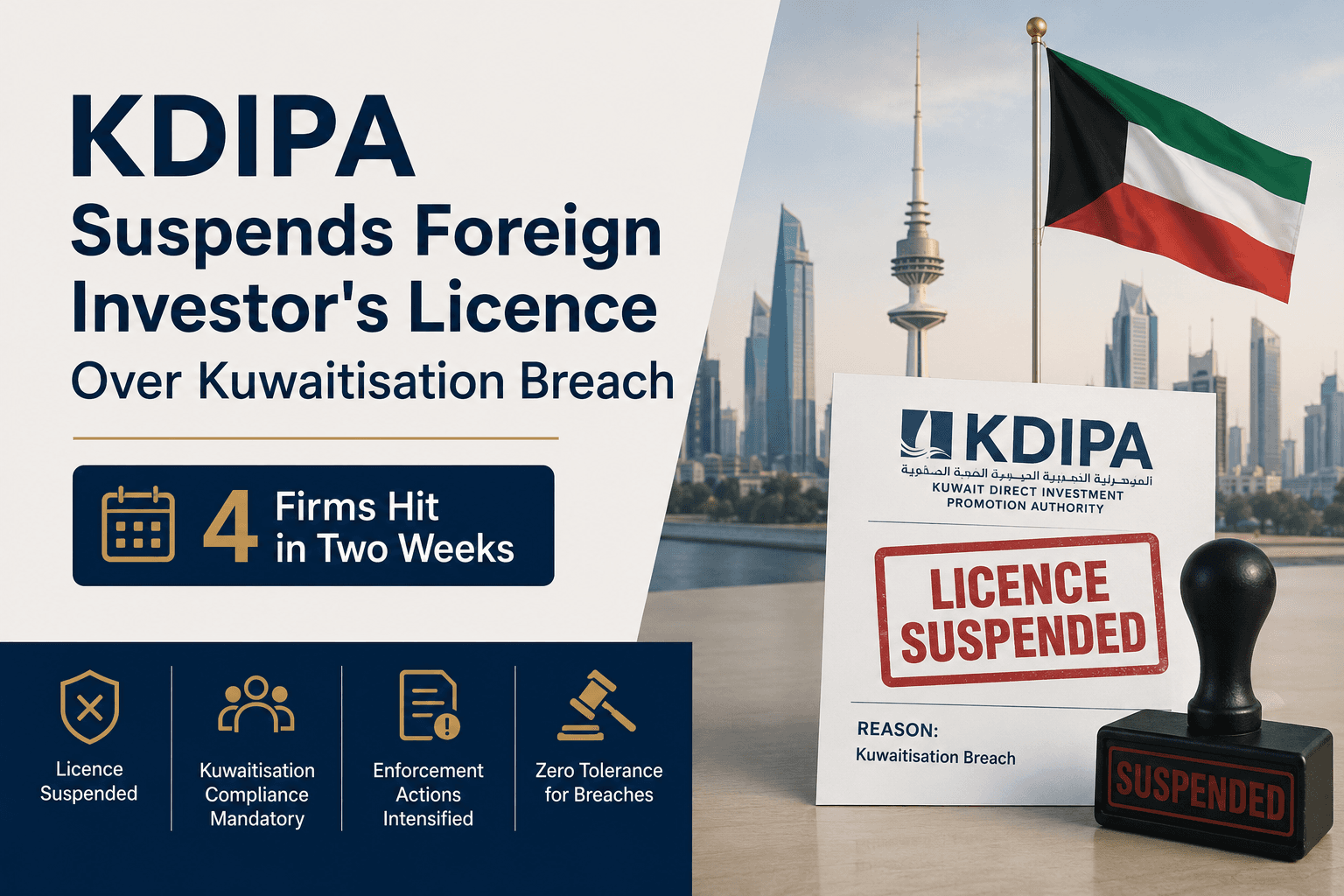
KDIPA Suspends Foreign Investor's Licence Over Kuwaitisation Breach; Four Firms Hit in Two Weeks
KDIPAKuwaitisationRegulatory EnforcementComplianceForeign Investment

KDIPA Suspends Foreign Investor's Licence Over Kuwaitisation Breach; Four Firms Hit in Two Weeks

The Kuwait Direct Investment Promotion Authority (KDIPA) has temporarily suspended the investment licence of a foreign power-sector investor for failing to meet the Kuwaiti-national workforce ratio attached to its licence — the latest in a wave of enforcement actions that has touched four foreign companies in roughly two weeks. The suspension was formalised by Ministerial Decision No. 207 of 2026, issued by the Minister of State for Economic Affairs and Investment in his capacity as Chairman of KDIPA, and published in the Official Gazette (Kuwait Al-Youm), Issue No. 1793, dated 31 May 2026, at page 76. The decision names the investment entity “Shanghai Engineering Company for Electric Power Transmission and Distribution Limited” (commercial licence 4728/2017; investment licence 24/2017-T1) and cites a breach of licence conditions for not employing the agreed number of national workers. The decision rests on follow-up and audit reports dated 23 December 2025 and 14 April 2026 and a KDIPA board resolution taken at its meeting No. 1/2026 on 16 April 2026. The entity has been ordered to submit proof that the violation has been remedied no later than 7 July 2026; failing which it becomes exposed to the more severe penalty under Article 32 of the Direct Investment Promotion Law No. 116 of 2013. Local press (Times Kuwait, 1 June 2026) reported that KDIPA had, in the same short window, cancelled the licences of three further foreign companies following similar compliance reviews — signalling a clear shift from incentive-led promotion toward active, audit-driven oversight that links investment privileges to measurable national-economy contribution, including Kuwaitisation and knowledge transfer. For foreign investors operating under a KDIPA licence, the message is direct: the national-workforce undertakings given at licensing are now being tested against audit evidence, and remediation windows are short. Affected entities should treat a suspension notice as a time-critical matter requiring an immediate compliance and representation strategy. Sources: Kuwait Al-Youm, Issue 1793, 31 May 2026, p.76 (Ministerial Decision No. 207/2026); Times Kuwait, “KDIPA suspends, delists four foreign companies within two weeks”, 1 June 2026.

Learn more
Kuwait's Supreme Petroleum Council Approves KIPIC–KNPC Merger by Absorption
Oil & GasMergers & AcquisitionsEnergyCorporate Restructuring

Kuwait's Supreme Petroleum Council Approves KIPIC–KNPC Merger by Absorption

Kuwait City — Kuwait's Supreme Petroleum Council (SPC) has approved the merger of Kuwait Integrated Petroleum Industries Company (KIPIC) into Kuwait National Petroleum Company (KNPC), consolidating two downstream subsidiaries of Kuwait Petroleum Corporation (KPC) into a single national refiner. The decision was taken at SPC Meeting No. 132 (2026/4) on 29 April 2026 and published in the official gazette, Kuwait Al-Youm, at the end of May 2026. Under it, KIPIC ceases to exist as a separate legal entity and KNPC succeeds to all of KIPIC's assets, rights, obligations and liabilities by way of universal succession — a merger by absorption. To give effect to the merger, the SPC approved an increase in KNPC's capital equal to the book value of KIPIC's assets as at 31 March 2026, lifting KNPC's capital to approximately KD 2.63 billion (about US$8.5 billion). The plan provides for compensation of KIPIC's minority shareholders — other than KPC — based on an approved asset valuation, and for amendments to KNPC's articles of association to absorb KIPIC's refining, petrochemicals and LNG-import operations at Al-Zour. The Minister of Oil, in his capacity as KPC chairman, is authorized to set the effective date and oversee implementation, including the final termination of KIPIC's legal status. The consolidation is the most significant restructuring of Kuwait's downstream petroleum sector in years. It carries direct consequences for KIPIC's contractors, suppliers and counterparties, whose agreements, guarantees and disputes transfer to KNPC by operation of the merger. ► Source: Supreme Petroleum Council Decision, Meeting No. 132 (2026/4), 29 April 2026; published in Kuwait Al-Youm (late May 2026). Cross-referenced with Reuters/Zawya, Kuwait Times and AGBI reporting, June 2026. [Confirm exact gazette issue & page against the relevant Kuwait Al-Youm issue before citing in print.]

Learn more
Kuwait Competition Authority Publishes Merger Notice in Foxconn–Mitsubishi Fuso Bus Deal; 15-Day Objection Window Opens
Competition LawMerger ControlCPAMergers & AcquisitionsCross-border Transactions

Kuwait Competition Authority Publishes Merger Notice in Foxconn–Mitsubishi Fuso Bus Deal; 15-Day Objection Window Opens

Kuwait City — The Kuwait Competition Protection Authority (CPA) has published a notice of an economic concentration in the Official Gazette “Kuwait Al-Youm,” Issue No. 1793 (page 180), dated 31 May 2026, inviting any interested party to submit a reasoned objection within fifteen (15) days of publication. According to the notice, Lin Yin International Investments Ltd (Taiwan) — a company wholly owned by Hon Hai Precision Industry Ltd (Foxconn) — has applied for clearance to acquire 50% of the shares of Mitsubishi Fuso Bus Manufacturing Ltd (Japan), currently held by Mitsubishi Fuso Truck and Bus Corporation. The filing is made under Law No. 72 of 2020 on the Protection of Competition and Article 83 of its Executive Regulations issued by Resolution No. 14 of 2021 (as amended). The transaction forms part of a wider global arrangement announced in January 2026, under which Foxconn and Mitsubishi Fuso plan to establish a new Japan-based zero-emission bus manufacturer. Its appearance in Kuwait’s Gazette confirms that the parties’ activities meet the local notification thresholds — a reminder that Kuwait’s merger-control regime reaches global transactions with a Kuwaiti nexus. Under Article 83, “any interested party may submit a reasoned objection to the economic-concentration application within fifteen days from the date of notification or publication.” Objections are filed at the CPA’s headquarters, Al-Hamra Tower, 14th floor, using the form available on the Authority’s website and on payment of the prescribed fee. The notice lands shortly after the CPA raised its merger-control thresholds by Resolution No. 32 of 2026 (effective 5 April 2026), lifting the single-party Kuwait turnover threshold to KD 1.5 million. Businesses with sales or assets in Kuwait that are party to cross-border deals should assess, early in any transaction, whether a Kuwaiti filing is triggered — the law requires application within 60 days of the relevant agreement. Source: Kuwait Al-Youm, Issue 1793, page 180 (Competition Protection Authority notice), 31 May 2026.

Learn more
Comprehensive Overview of Kuwait's New Residency Law for Foreigners (Decree No. 114/2024)
Residency LawForeign ResidencyInvestor ResidencyProperty OwnershipImmigration

Comprehensive Overview of Kuwait's New Residency Law for Foreigners (Decree No. 114/2024)

On November 28, 2024 , Kuwait’s Amir issued Decree No. 114/2024 , introducing a modernized Residency Law for Foreigners. The law, consisting of 36 articles across seven chapters , replaces the outdated legislation from 1959. It aims to address current challenges, regulate residency practices, and attract investment while ensuring national security. Key Provisions of the Residency Law: 1. Entry and Exit Requirements: Article 1: Foreigners must possess a valid passport or equivalent travel document issued by their country of origin to enter or exit Kuwait. Citizens of GCC countries may enter with personal ID cards. Article 2: The Ministry of Interior determines the types of entry visas and the procedures for obtaining them. Article 3: Citizens of certain countries may be exempt from entry visas based on reciprocity agreements. Article 4: Entry and exit must occur through designated ports, following procedures set by the Ministry. Article 5: Transport operators, such as airline captains and shipmasters, must provide passenger lists and report any unauthorized passengers to the authorities. 2. Notification Requirements: Article 6: Births within Kuwait must be reported to authorities within four months. Newborns must obtain residency permits or leave the country. Article 7: Foreigners must report lost or damaged passports within two weeks. Article 8: Hotels and furnished apartments must inform authorities about foreign guests within 48 hours of their arrival or departure. 3. Residency Permits: Article 9: Foreigners intending to reside in Kuwait must obtain a residency permit from the Ministry of Interior. Article 10: Kuwaiti women can sponsor their non-Kuwaiti husbands and children for residency, provided they did not acquire Kuwaiti citizenship through marriage. Article 11: Visitors are allowed to stay for a maximum of three months under a visit visa, extendable only through a residency permit. Article 12: Temporary residency permits, lasting up to three months and renewable for one year, are available under specific conditions. Article 13: Regular residency permits are capped at five years. However: Children of Kuwaiti Women are eligible for permits up to 10 years. Property Owners can receive permits of up to 10 years. Investors are eligible for permits of up to 15 years. Importantly, Article 13 introduces residency rights for property owners, signaling a potential shift in Kuwait's policies. Although foreigners are currently prohibited from owning property in Kuwait, this provision suggests that reforms may be underway to allow foreign ownership in the future. Such a change would align with efforts to attract foreign investment and stimulate economic development. Article 14: Domestic workers receive residency permits matching their employment contracts. Upon contract termination, residency is canceled, requiring departure within a specified timeframe. Article 15: Government employees or private sector workers can obtain residency permits upon employer request. Article 16: Sponsors must notify authorities if a foreigner overstays their visa or residency. Article 17: The Ministry of Interior sets fees for residency permits and entry visas. Children of Kuwaiti women are exempt from these fees. 4. Employment and Residency Compliance: Article 18: Residency trafficking, including exploiting foreigners for financial gain, is strictly prohibited. Article 19: Foreigners cannot work for employers other than their sponsors, and sponsors cannot misuse their permits for unauthorized purposes. 5. Deportation Rules: Article 20: The Ministry of Interior can deport foreigners lacking legitimate sources of income or violating the law, following a specified grace period. Article 21-26: Deportation rules allow foreigners time to complete tasks beneficial to the state and outline conditions for their potential return to Kuwait. 6. Penalties for Violations: Article 27-28: Violators face penalties including imprisonment, fines, or both for breaches of the residency law. Repeat offenders and public officials involved in residency trafficking may receive harsher punishments. 7. Exemptions and Special Provisions: Heads of state, diplomats, and their families are exempt from this law. The Ministry of Interior retains the authority to issue regulations and exceptions as needed. Special Residency Provisions for Investors and Property Owners Investors: Eligible for long-term residency permits of up to 15 years, fostering a favorable investment climate. Property Owners: Entitled to permits lasting up to 10 years, respecting constitutional rights to private property ownership. Key Highlights for Foreigners: This law emphasizes transparency, fairness, and security, aiming to balance Kuwait’s national interests with the needs of its foreign residents and investors. The Ministry of Interior is responsible for issuing detailed regulations to facilitate the law's implementation within the next six months. This comprehensive overhaul is expected to have far-reaching impacts on expatriates, sponsors, and businesses in Kuwait. Compliance with the new residency rules is essential to avoid legal repercussions.

Learn more