
Kuwait’s Bonds & Sukuk Regime Is Now Live: A Practical Roadmap for Issuers and Arrangers
13-06-2026
Bonds & SukukCapital MarketsCMA
For the first time in its history, the Kuwaiti capital market can host listed bonds and sukuk issued by both domestic and foreign companies. With Boursa Kuwait now confirming that its dedicated fixed-income board is operationally and technically ready, the question for treasurers, CFOs and arrangers has shifted from whether the regime exists to how to use it. This note sets out a practical roadmap.
The regulatory architecture
The framework rests on two instruments. First, CMA Resolution No. 38 of 2026 amends the Executive Bylaws of Law No. 7 of 2010 and builds a complete legal scaffold for fixed-income instruments — covering issuance, listing, ongoing disclosure, trading, and the end of an instrument’s life through early redemption or maturity. Second, Boursa Kuwait Resolution No. 1 of 2026 amends the exchange rulebook to operationalise that scaffold, adding bond- and sukuk-specific provisions and establishing a separate trading board with sessions designed for fixed income rather than equities. The practical effect is that issuers no longer need to look exclusively to bank facilities or to offshore markets to raise debt; a domestic, regulated, listed route now exists.
What an issuer must satisfy
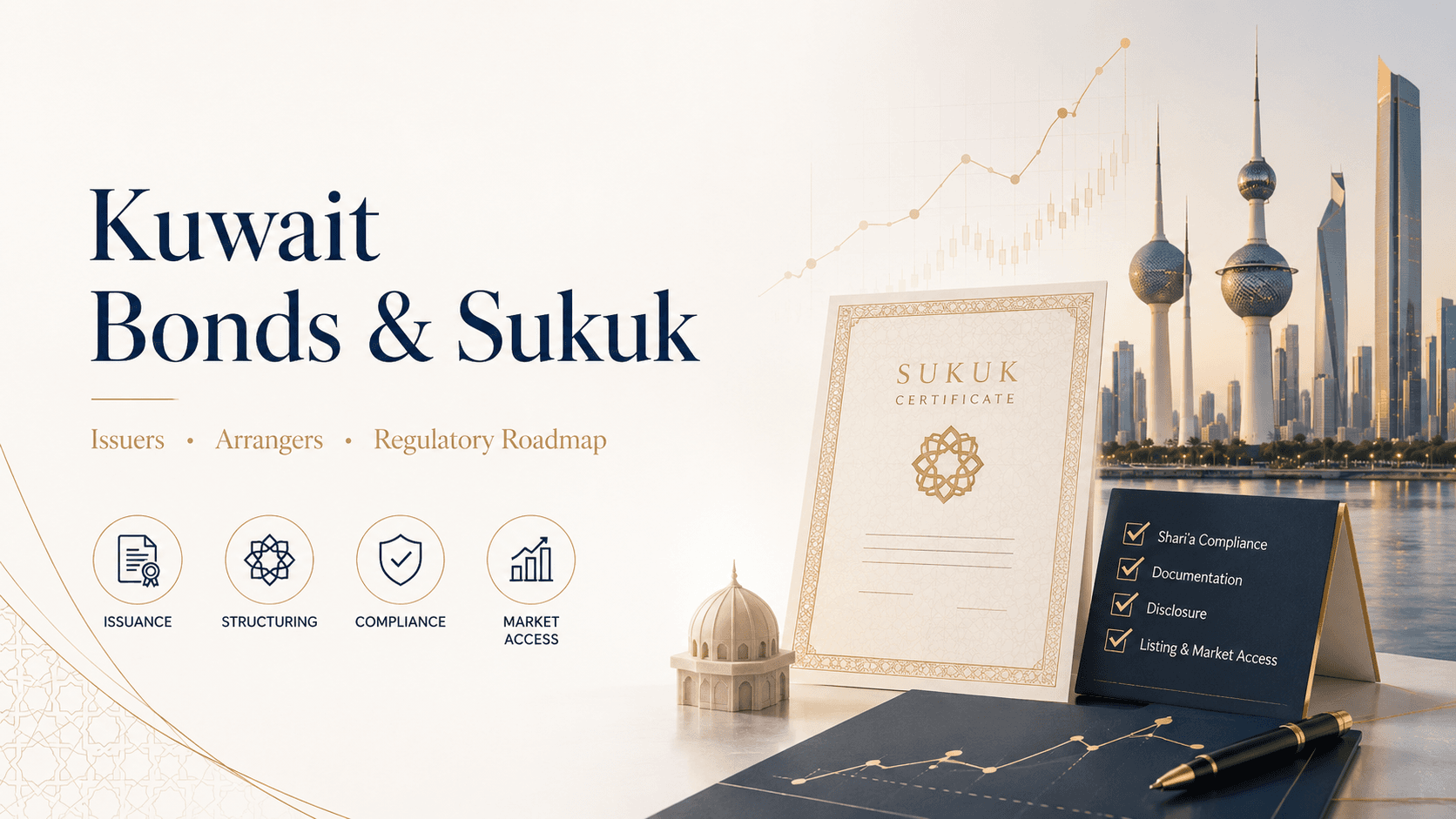
The headline conditions are clear and should be diligenced early. The minimum issuance value is KD 100,000 (or its foreign-currency equivalent), which keeps the door open to mid-sized as well as benchmark issuers. A credit rating from a recognised agency is mandatory — issuers without an existing rating should begin engagement with a rating agency well ahead of any launch, as the timeline for a first-time rating frequently drives the critical path. The instruments must be freely tradable without restriction, so embedded transfer limitations common in private placements will need to be removed or restructured. A representative body must be appointed to act for, and protect the interests of, holders — a governance feature that issuers should reflect in their documentation and intercreditor arrangements. For sukuk, Sharia compliance is required, which means the structure (and its underlying assets and contracts) must be approved by a Sharia board and remain compliant throughout the life of the instrument.
Why this matters commercially
The regime gives issuers a genuine funding alternative to bilateral or syndicated bank borrowing, often at competitive cost, and access to a broader and more diversified investor base — institutional funds, treasuries and, over time, retail fixed-income demand. For Kuwaiti corporates with large, long-dated capital programmes — real estate developers, contractors operating PPP concessions, financial institutions managing capital ratios — a listed local-currency instrument can match funding tenor to asset life in a way short-term bank facilities cannot. For foreign issuers, a Boursa Kuwait listing offers a regulated channel into Kuwaiti dinar liquidity.
The execution path — where legal counsel earns its place
A first issuance under a new regime carries execution risk precisely because there is little local precedent. Counsel should be engaged at structuring, not at signing. The workstream typically runs: (1) entity and authorisation review — confirming corporate power to issue and the necessary board and, where relevant, shareholder approvals; (2) structuring — conventional bond versus sukuk, tenor, security or unsecured, and for sukuk the choice of underlying structure; (3) ratings and credit support engagement; (4) drafting the offering and listing documentation to CMA and Boursa Kuwait standards, including the holder-representation mechanics; (5) the CMA approval and Boursa listing application; and (6) closing and admission to the new board. Sharia governance, disclosure liability, and continuing-obligation compliance run through each stage.
What to do this quarter
Issuers contemplating a raise in 2026 should commission a readiness assessment now: confirm corporate authority, open the ratings conversation, and map the instrument to the balance sheet. Being among the first to list will attract investor and media attention — an advantage worth capturing, but only on documentation that withstands scrutiny. WEFAQ’s Banking, Finance & Regulatory team advises issuers and arrangers across structuring, documentation and the CMA/Boursa approval process. We would be glad to discuss how the new regime fits your financing plans.
Sources: CMA Resolution No. 38 of 2026 (amending the Executive Bylaws of Law No. 7 of 2010); Boursa Kuwait Resolution No. 1 of 2026; Boursa Kuwait operational-readiness announcement, June 2026. General information, not legal advice.
Related articles


Eight Clearances, One Gazette: What Kuwait's Latest Merger-Control Batch Tells Global Dealmakers
Learn more
Yield on Idle Client Cash and a Bounded Margin Facility: A Broker’s Roadmap to CMA Resolution 85/2026
Learn more
Faster Benches: What Kuwait's Specialized-Court Reforms Mean for Business
Learn more
Kuwait's Disclosure Filing Switches to iFSAH Only: What Issuers, Licensed Firms and Auditors Must Do Now
Learn more